Wed
Jun 3, 2026
Playing Away 6: City of Sydney Basketball - Astronauts, Supersonics, Comets & Kings
NBL1.com.au

Patrick Skene - Cultural Pulse
Share on Social
Related Tags
Image credit: Damian Clark
Original piece - https://skeneinthegame.substack.com/p/playing-away-6-city-of-sydney-basketball
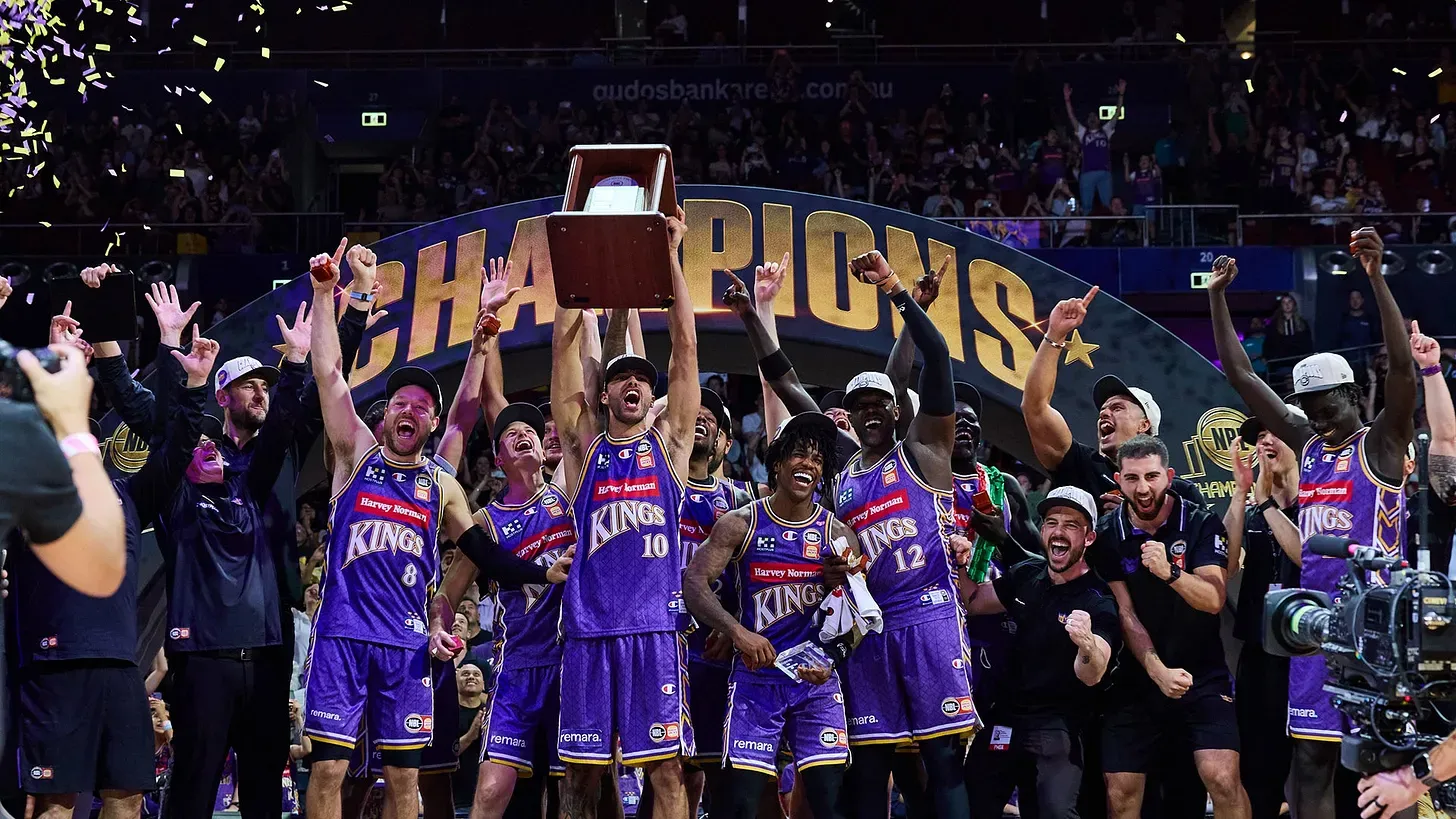
Easter Sunday 2026 was a tipping point for professional basketball in Australia. Brian Goorjian’s mighty Sydney Kings defeated the Adelaide 36ers in Game 5 of the NBL Finals series.
It was Network 10's highest ever NBL audience. ESPN's biggest NBL reach. An NBL record 18,589 fans in the stadium.
The Sydney Kings and the NBL had never looked bigger.
It was time for reflection. Where did the Kings juggernaut start? Where did the story begin?
The City of Sydney Basketball Association has had a rollercoaster journey that has been pivotal to the development of the professional game in Australia.
Since 1979, it has produced four basketball brands: the City of Sydney Astronauts, the Sydney Supersonics, the Sydney Kings, and the Sydney Comets. (Five if you count Sydney Sky, the short-lived 1994 Kings-affiliated youth team that played out of the same stadium and quietly fed a generation of professional-ready players into the NBL.)
All from one little association. All from one old building in Alexandria.
On a late autumn night I headed down to Comets Stadium for a ride down memory lane.
The Comets men’s NBL1 East side were preparing to play in their match against the Sutherland Sharks.
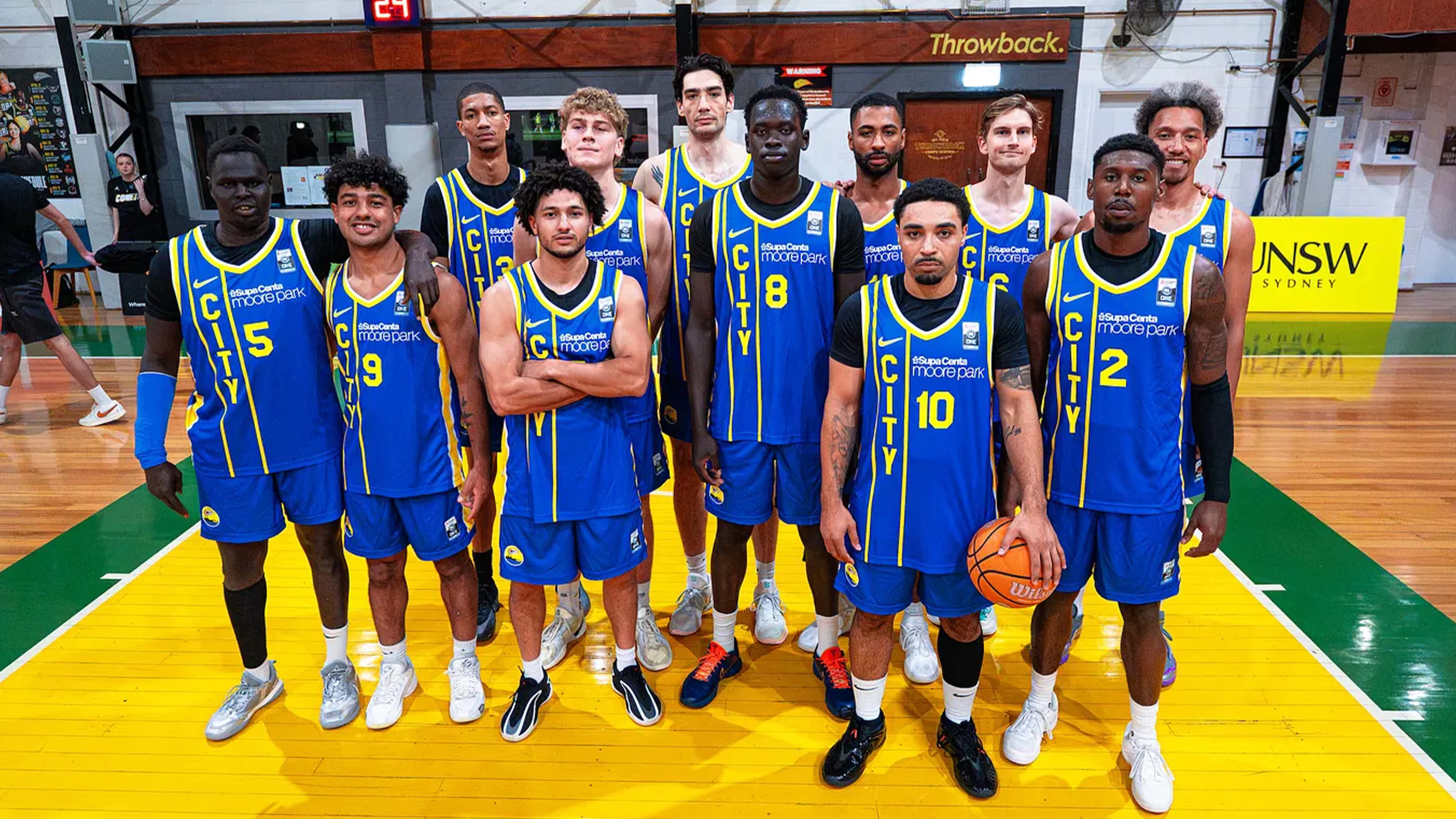
Tonight they were not wearing their traditional green and gold. Instead they were wearing blue and gold - the colours of the original 1979 City of Sydney Astronauts team, the colours that started it all.
It’s Heritage Round in NBL1, and there is no club in basketball that has heritage to wear quite like this one.
* * *
To find Comets Stadium you turn off Bourke Road into Maddox Street and into Perry Park. It’s a drive through past and present, a mix of functional industrial warehouses, new housing and converted offices.
This corner of Sydney has changed shape more times than most. In the nineteenth century the flat land along Shea’s Creek was given over to Chinese market gardens supplying the Sydney Produce Markets.
In the twentieth, the factories came. By 1943 there were five hundred and fifty companies operating here, producing everything from bricks to aeroplanes.
Perry Park itself was a garbage tip for two decades after Alexandria Council bought the land in 1935.
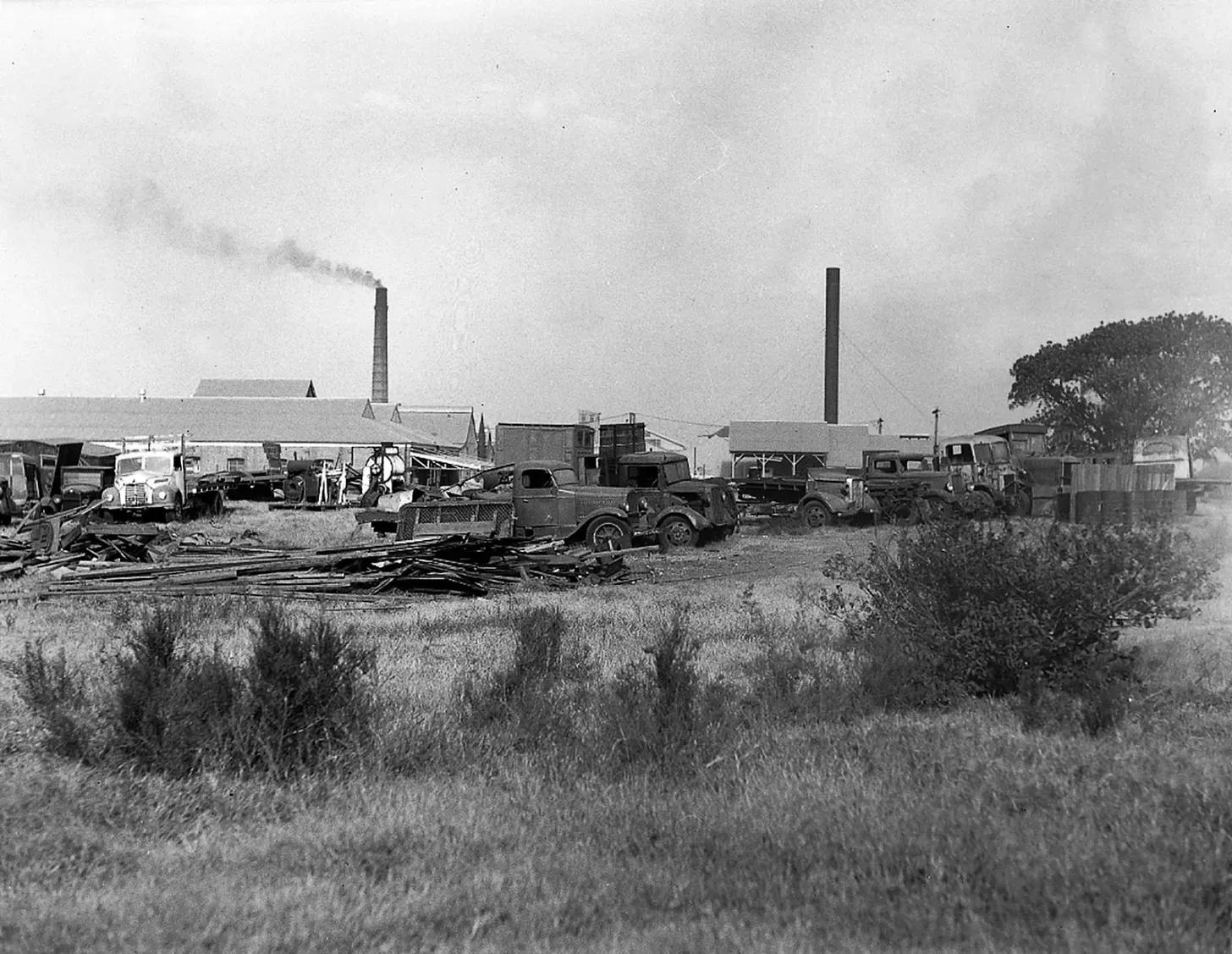 Industry encroaching into Perry Park, 1957 — Image: City of Sydney Archives
It wasn’t until 1967 that the first basketball hoops went up. Toilets and changing rooms followed ten years later. Today the City of Sydney Basketball Association holds a perpetual lease on one-tenth of the park, anchored by the two-court Comets Stadium.
It is, by the association’s own reckoning, the first proper basketball stadium ever built in inner Sydney. In 2028, the building turns 60. The original floorboards, give or take a patch, are still down there.
“For years we called it the old tin shed,” says Andrew Lazaris OAM, former elected President for 40 years, reportedly the second longest President’s reign of a professional sporting organisation behind Jorge Nuno Pinto da Costa, who served as the president of Portuguese football club FC Porto for 42 years.
He’s now the Honorary President and a life member of the City of Sydney Basketball Association and has been in and around the building since the 1970s.
“Like the old tin shed stadium at Rushcutters Bay. But people didn’t know where it was, so we just call it what it is. It’s the Comets Stadium.”
* * *
The old tin shed looks beautiful in the golden hour.
There is a large, colourful mural out the front but it is largely unchanged from when the Sydney Kings used to train there when I worked for the Kings many moons ago.
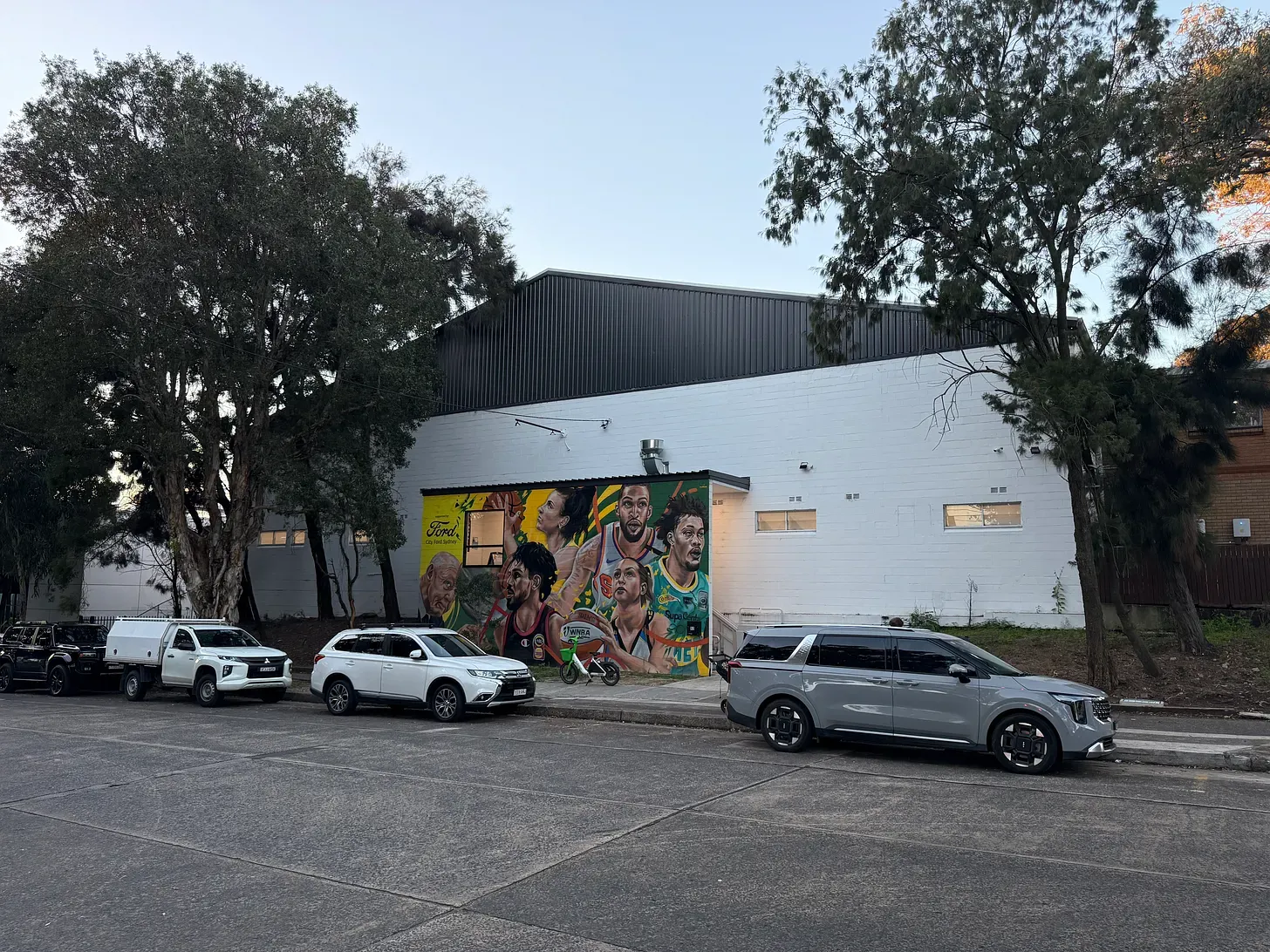 Comets Stadium affectionately known as the ‘Old Tin Shed’.
It’s still jolting to think that this building hosted more than 100 NBL games when the Sydney Astronauts played their home games here from 1979 to 1982, followed by the renamed Sydney Supersonics who also played here.
Walking in is a kind of time travel.
On the wall as you enter, in dark timber frames, are heritage jerseys from forty-six years of basketball history. The original 1979 Astronauts singlet of seventeen-year-old future Olympian Brad Dalton, the green-and-gold Supersonics tops with Cyprus Hellenic Club on the chest and Sydney Kings jerseys in royal purple.
The grandstand sits right on top of the court.
There is no buffer, no concourse, no corporate ring. No air conditioning. An old floor. Banners everywhere showcasing a history of success. Exposed metal roof beams with cobwebs give off a deep industrial vibe. Fans sit on the same old green and gold painted wooden benches, unchanged since the building’s infancy.
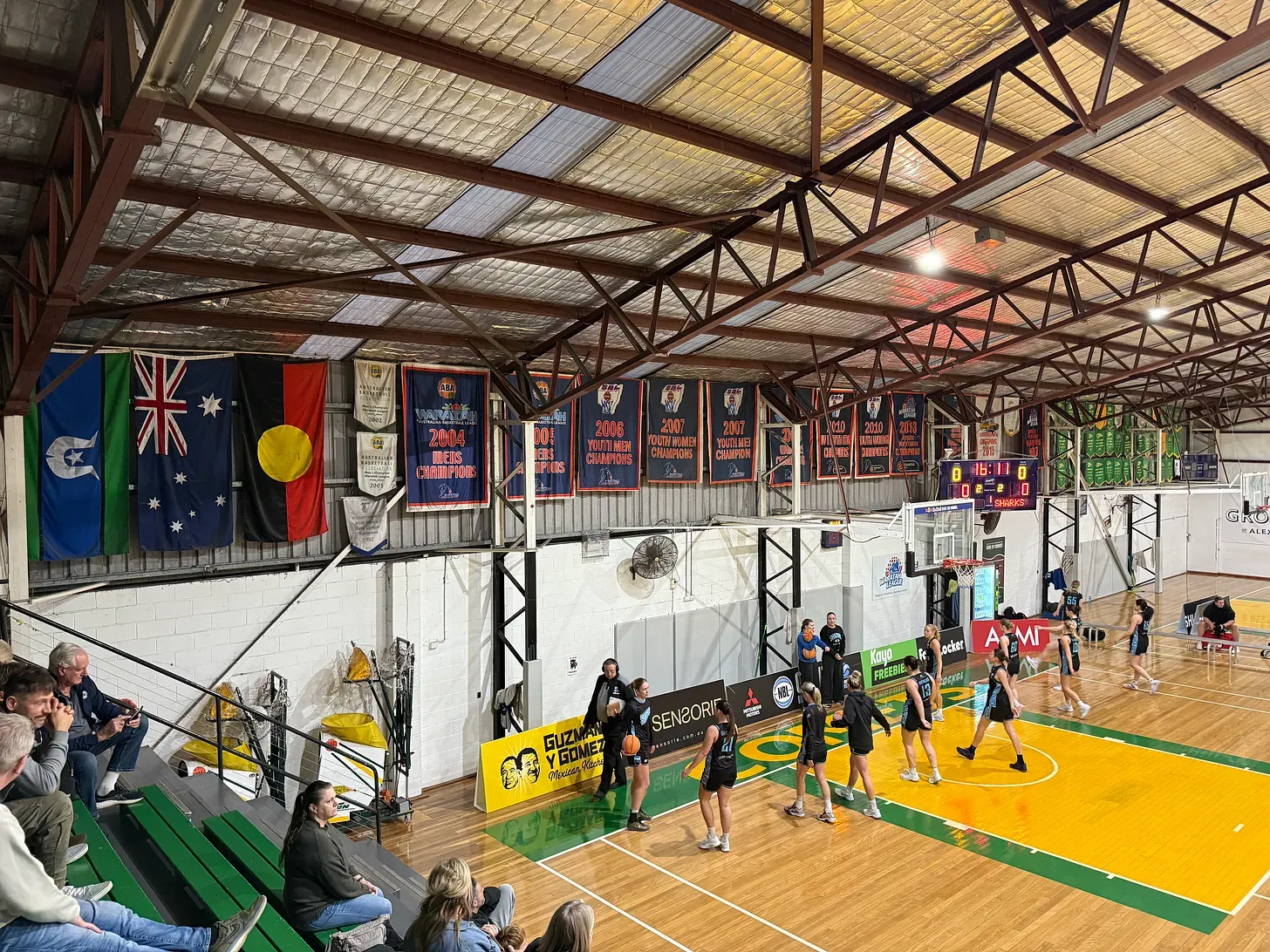 The Comets Stadium banners on both courts are a symbol of success and longevity.
On court the Women’s Comets’ team have their hands full tonight against a strong Sutherland Sharks team and the crowd can hear every shoe squeak, every rebound grunt, every questioning of a ref’s call.
Elemental basketball in a hardcore basketball stadium.
Despite battling to the end, the Comets eventually falter 70-63 against the Sharks.
Andrew Lazaris is waiting for me in the Comets bar, situated right above the court.
He has been involved with the City of Sydney Basketball Association in one form or another for more than five decades. Player. Administrator. Team manager. Owner. Patron. Recruiter. Strapper. Driver. Job-finder for imports. Personal financier when the bank wouldn’t come to the party.
He is the keeper of the flame for Sydney basketball’s foundation story. And he tells it with the urgency of a man who knows that if he doesn’t pass it on, no-one else will.
“The other night when we presented the heritage jerseys to the players,” he says.
“There was nobody in our office, I don’t even think any board members who knew why we were originally blue and gold.”
So why were the Astronauts blue and gold?
“Because that’s the colour of the Sydney coat of arms,” Lazaris says.
“The Lord Mayor of Sydney was our patron back in 1979 when the league first started. That’s why City of Sydney was blue and gold. It’s the same reason City wears blue and gold in City vs Country in rugby league. Those are Sydney’s colours.”
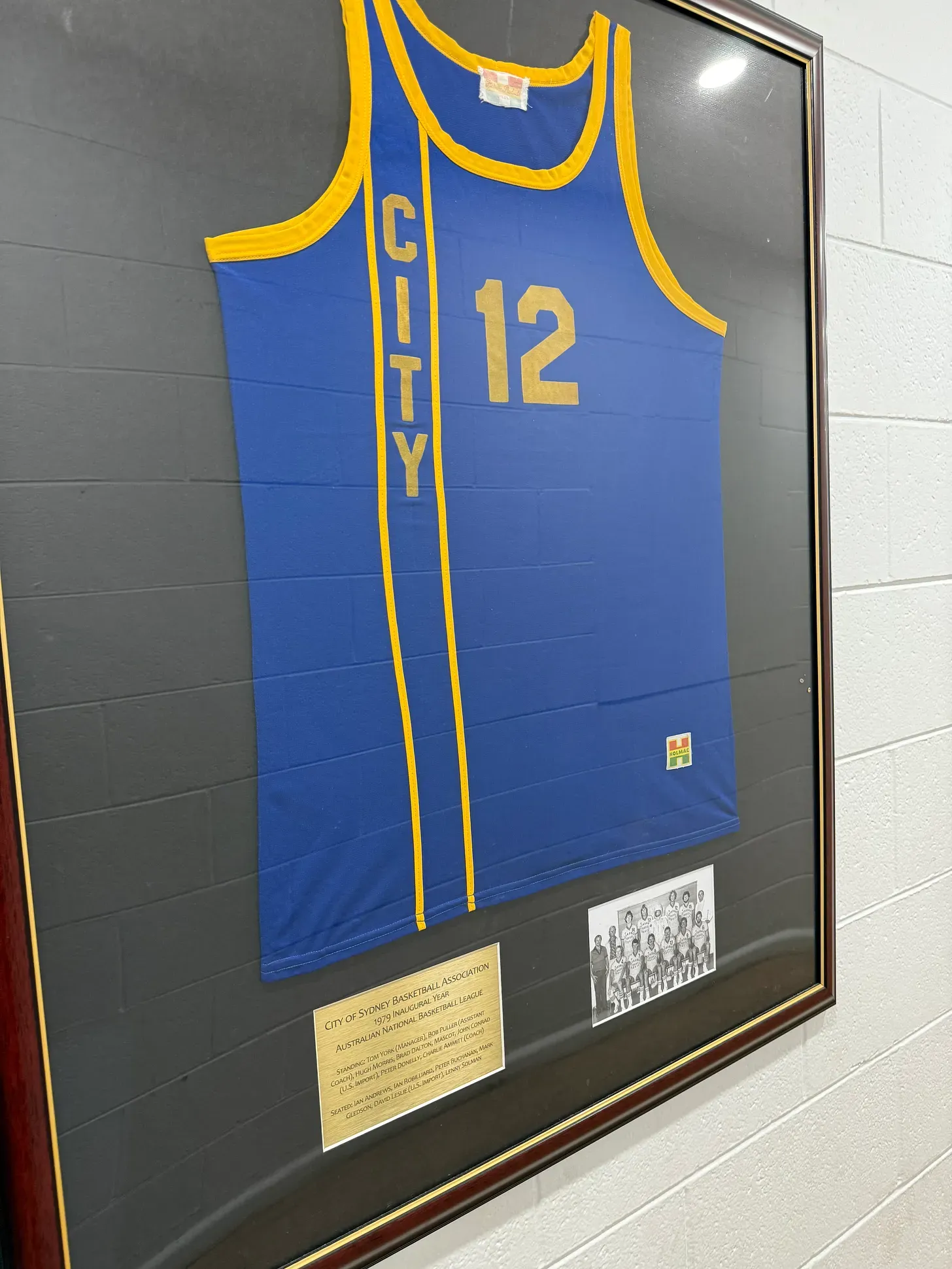 The original Sydney Astronauts jersey worn by a 17 year old Brad Dalton who would go on to represent Australia.
I wondered about the nickname. Was it linked to celestial ambition and pioneers setting new frontiers?
Sadly not.
“Astronaut Travel was our sponsor. They gave us return airfares for our American imports. So we were the City of Sydney Astronauts.”
In 1979, that was what a foundation NBL jersey sponsorship looked like. Two plane tickets.
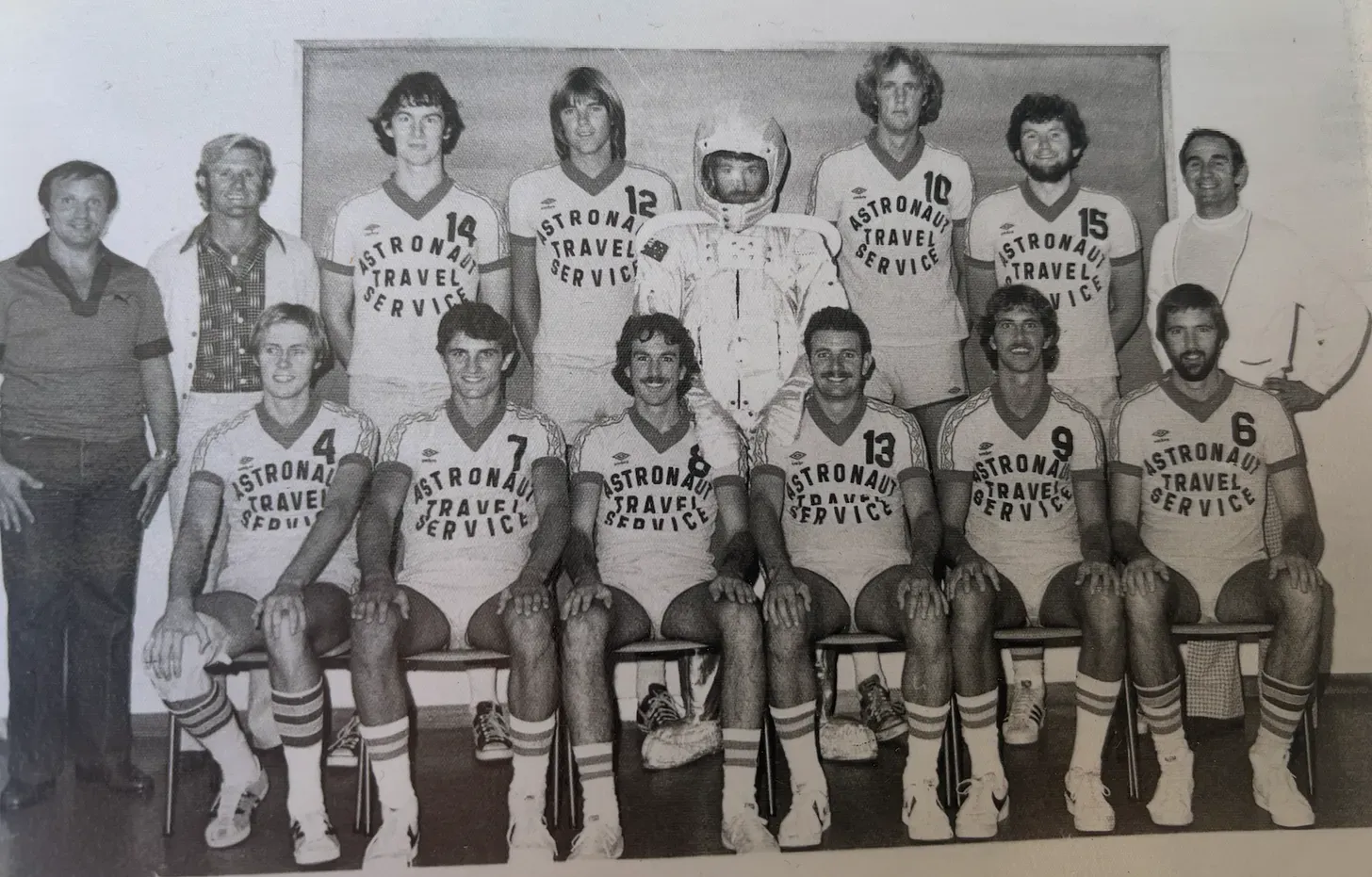 The Sydney Comets in 1979 - pioneers for professional basketball in Sydney
Lazaris’ involvement started earlier. As a young rep player with Eastern Suburbs, he was central to the amalgamation of Eastern Suburbs with the old City basketball association.
The merger that produced the entity that would be invited into the inaugural NBL. He sat in on the player meetings when an all-star Sydney team was being put together to face Glenelg in the league’s opening night.
“The players came in for interviews. We told them: there’s a national league starting. We’ve selected you. And the great news is, it’s not going to cost you to play. We’ll pay for it.”
In the late seventies, that was a revolutionary sentence. The norm was the opposite -back then players had to pay for the privilege of representing their state.
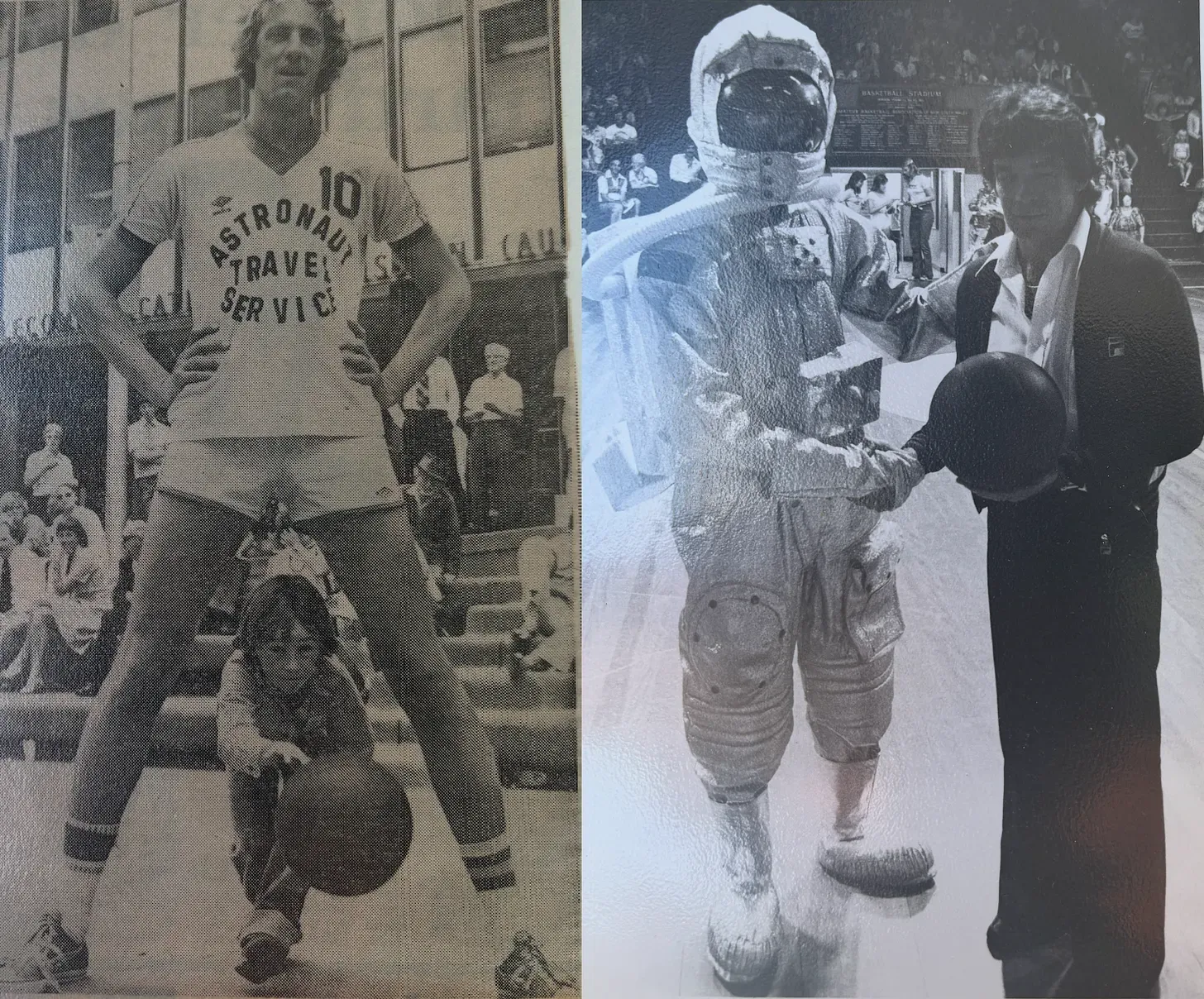 Left - A Daily Telegraph story from 1979 featuring Astronauts 209cm import John Conrad at Martin Place.
Right - Socceroo legend Johnny Warren with the Astronauts mascot.
Three years in, the Astronauts became the Supersonics.
In naming the new brand, Lazaris had gone through the NBA teams looking for an aesthetic fit.
He landed on Seattle Supersonics, whose skyline he thought looked like Sydney’s. A sister-club relationship followed, then green and gold uniforms in Seattle’s colour palette.
That the team’s new sponsor, the Cyprus Hellenic Club in Elizabeth Street, where Lazaris’ uncle was president, also wore green and gold. A fortunate coincidence.
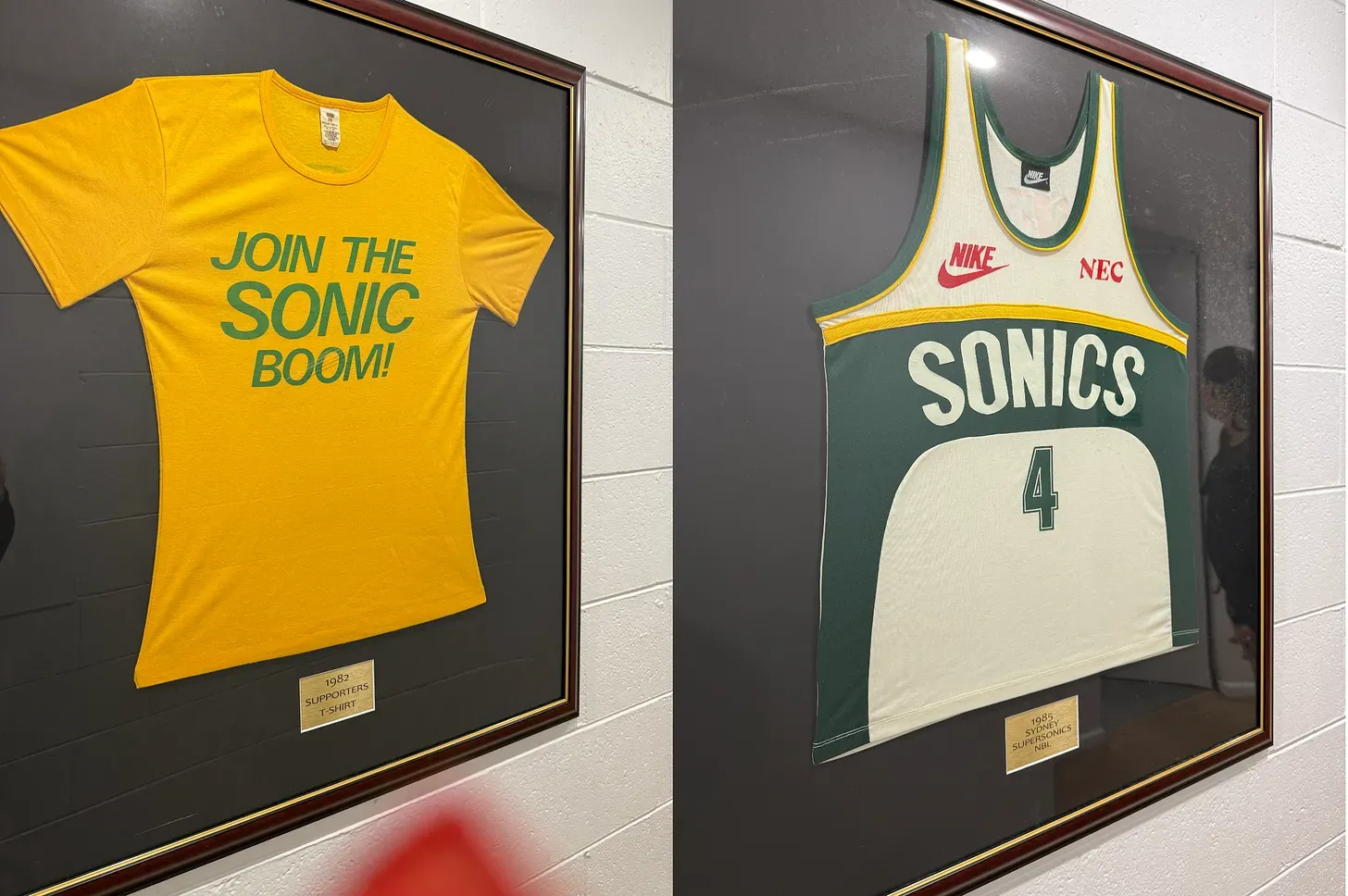 The Sydney Supersonics followed the Astronauts and their colours and name were adopted from the Seattle Supersonics.
By 1983, Sydney looked ready to win an NBL title with a roster including Brad Dalton, Claude Williams, Kurt Forrester, Gordon McLeod and the once-in-a-generation talent Owen Wells, a man Lazaris still describes, eyes wide, as “something else”.
Wells was MVP of three different national leagues across his career: Italy, Holland and Australia. “There’s not a player that has done that,” Lazaris says.
A run of bad luck saw the Supersonics season end with the team seventy-five thousand dollars in the red.
Lazaris’ own bank overdraft came to the rescue. His own house collateral. His own father refused to speak to him over the money he was pouring in.
“I could have bought a couple of houses with the money I went through. But no regrets.” he says.
The fix, when it came, was an idea from his accountant Tom York, who was at that point the inaugural treasurer of the NBL itself.
Tom suggested a private ownership model was the solution, based on the American sports ownership model.
When Kerry Packer questioned Andrew, he recalls telling Packer: “We’re not selling Basketball, we’re selling entertainment.”
Five men put twenty thousand dollars each on the table. Lazaris. The brothers Wrublewski. A solicitor. A brother-in-law. The Sydney Supersonics, in 1985, became the first privately-owned franchise in any sport in Australian history, setting the tone for many to follow.
Three years later the team rebranded again. The Lakers were the team of the moment in the NBA.
“We said: we want to be the Lakers of Sydney. We want to be the Kings of basketball here.” Lazaris recalled.
Purple and gold. Sydney Kings. 1988.
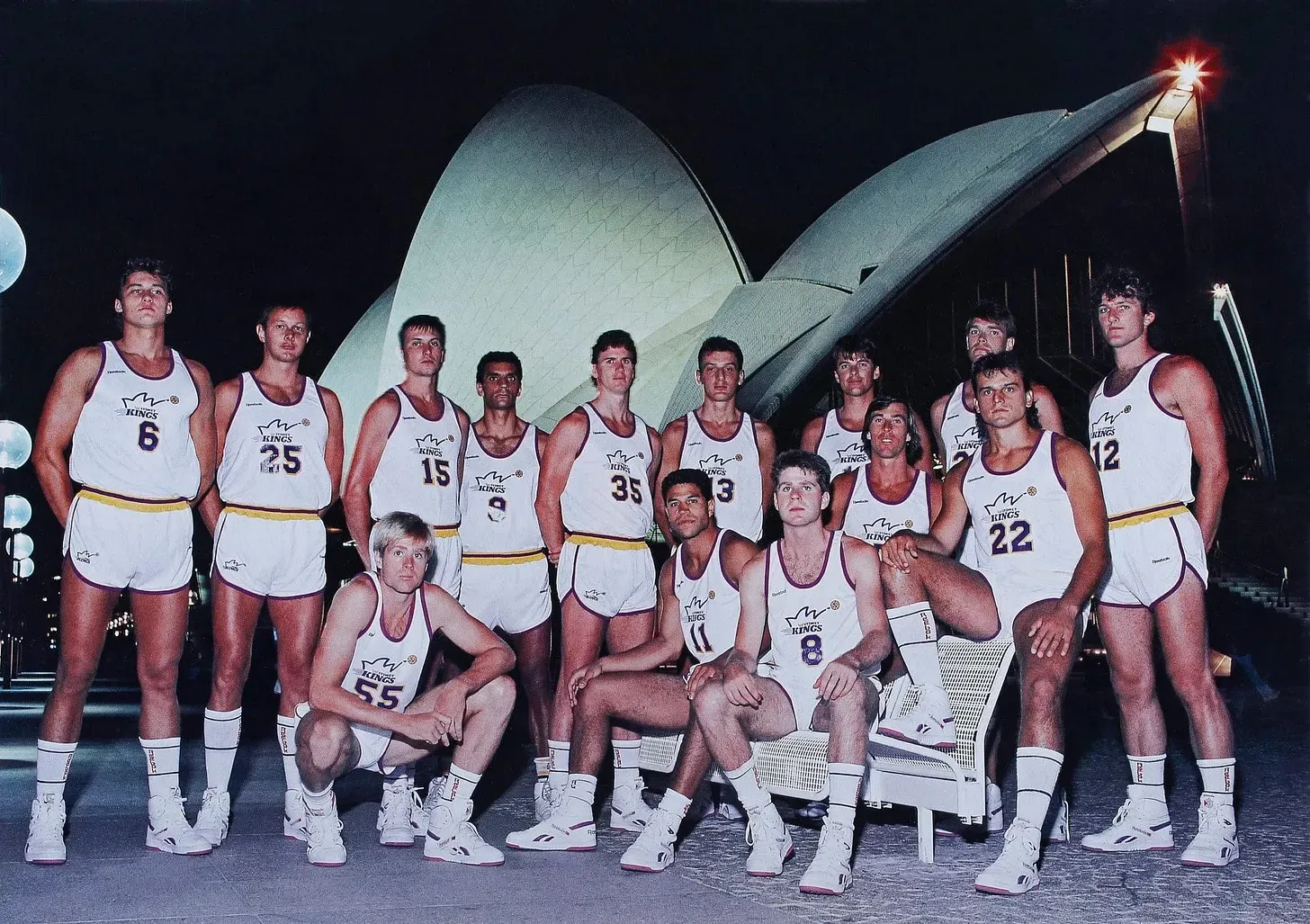 The early Sydney Kings won the hearts of Sydneysiders and their legacy continues today.
With that one rename, the Supersonics name was retired at NBL level and given to the association’s representative teams underneath. Briefly. Then those rep teams were renamed again to keep the IP separate.
“We said: a supersonic comet sounds good. So we changed the rep teams to the Sydney Comets.”
So the lineage runs: Astronauts (1979) → Supersonics (1982) → Comets (mid-1980s, when the Supersonics name moved to private ownership) → Kings (1988, when the NBL team became its own brand).
And in 1994, a fifth brand. The Sydney Kings established a youth-team affiliate called Sydney Sky, playing out of the same stadium with the same juniors including a young guard named Matt Nielsen and a young point guard named Brad Rosen. Sky lasted two seasons. The Comets continued.
When the Kings collapsed and went into administration in 2008 from the ‘Firepower’ scandal, it was Lazaris that intervened to protect the Sydney kings brand.
“We had to keep the name alive,” Lazaris says. “They could have come in and buried the Kings. I went to the NBL: it’s got to be the Sydney Kings, mate. It’s got to be.”
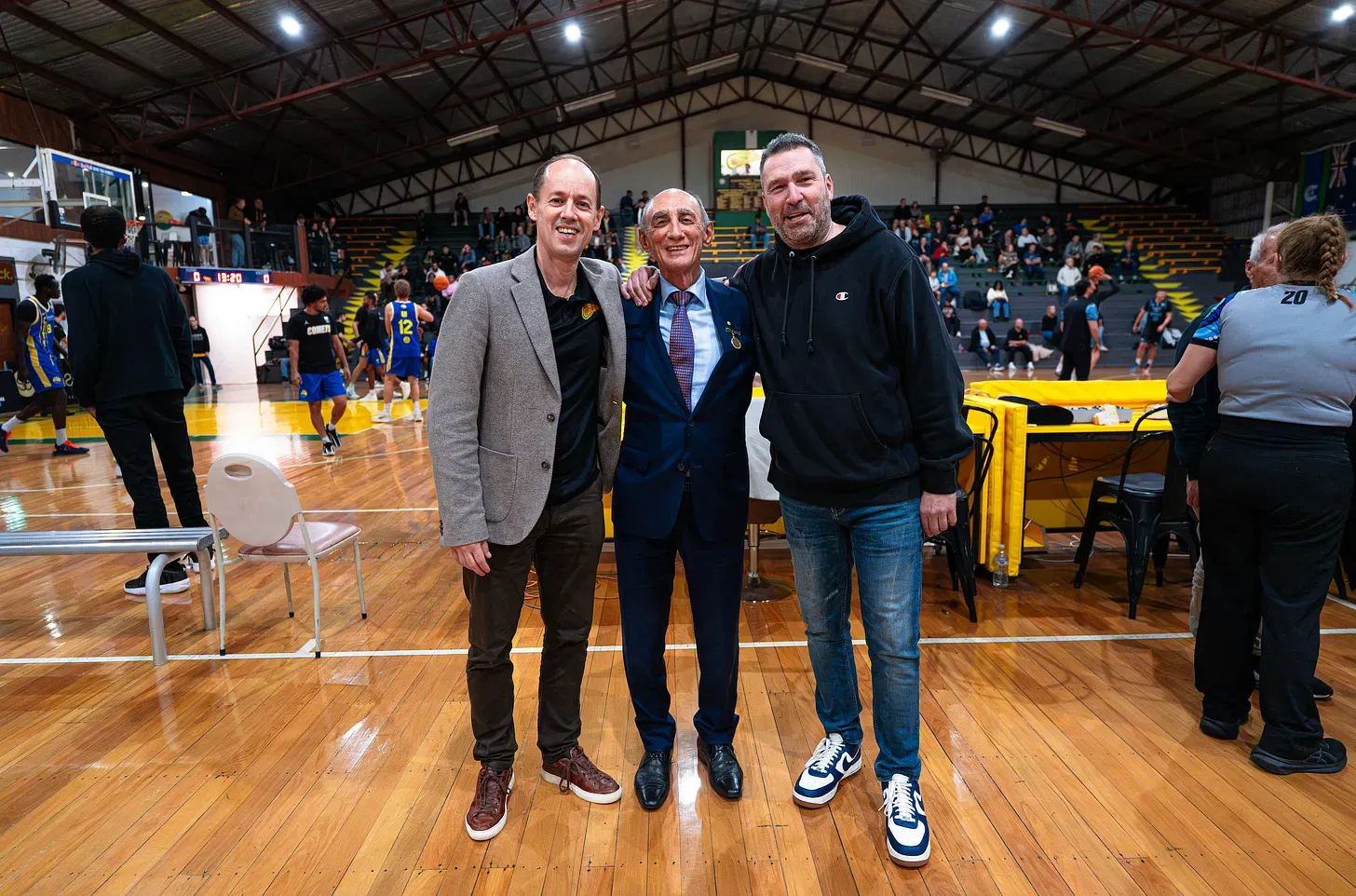 Comets CEO Mike Anderson (left) with club patron Andrew Lazaris and club legend Brad Rosen. (Credit: Damian Fraser Clark)
Mike Anderson took over as CEO of the City of Sydney Basketball Association in February of this year, after a career in netball, the South Sydney Rabbitohs and the Sydney Cricket and Sports Ground Trust.
He had spent the previous five years in Queensland. He was looking for something hands-on after a long run in what he calls “the ivory tower” of big sporting bodies.
“I’d been in some of the big organisations. Coming to City of Sydney has been a real whirlwind, but I love being hands-on at the grassroots. Working with a small team, a huge number of volunteers, across both representative programs and local basketball.
“To come into an organisation with this much history, this much passion, this kind of brand and reputation in the industry - it’s special. But we also need to start being run like a business if we’re going to last.”
On paper, the Comets shouldn’t still be one of the leading associations in Sydney basketball. Their socioeconomic catchment doesn’t have the density of Hills or Norths. They have one stadium with two courts, where their competitors have five times the staffing and much bigger budgets.
And yet, the growth keeps coming.
Three and a half thousand players. Twenty-six junior representative teams. Five senior representative teams. Eight training venues from the inner city out to the eastern and southern suburbs and five competition venues. The largest junior representative program in Sydney.
Strong female programs. Major indigenous representation with more than 10% of members from Aboriginal and Torres Strait Islander background.
“We punch above our weight,” Anderson says. “But we need to evolve as an organisation so we can keep growing.”
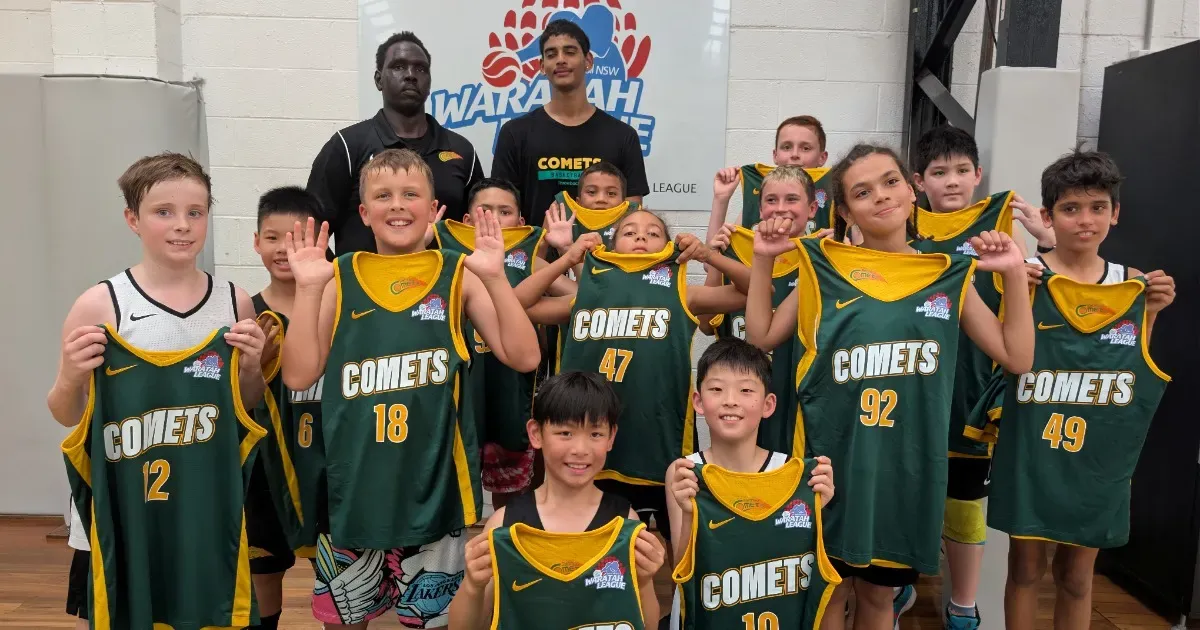 The Sydney Comets Junior program is thriving.
For Anderson, the Comets are above all a pathway club.
The 26 junior teams feed the youth league. The youth league feeds NBL1. NBL1 feeds not only the NBL, but now the NBA Summer League. Two years ago, Comets juniors Biwali Bayles and Davo Hickey became the first teammates in NBL1 history to earn spots on NBA Summer League rosters in the same off-season.
“That’s the most important thing,” Anderson says.
“When the rep kids can see a team that isn’t full of imports, a team built around homegrown local talent who came through this same building. That’s enormous for the club. We want to keep that. That has to be who we are.”
The heritage round, he says, has caught fire in a way nobody quite expected.
“The interest in the old city of Sydney blue and yellow jersey has been off the charts. We had a session last Tuesday night where Andrew and I presented the jerseys to all the players, and Andrew told stories for a couple of hours. The players found them compelling.”
“People want to understand where this club came from. We’ve had a number of life members pass away this year. They’re getting old. We have to make sure the stories survive.”
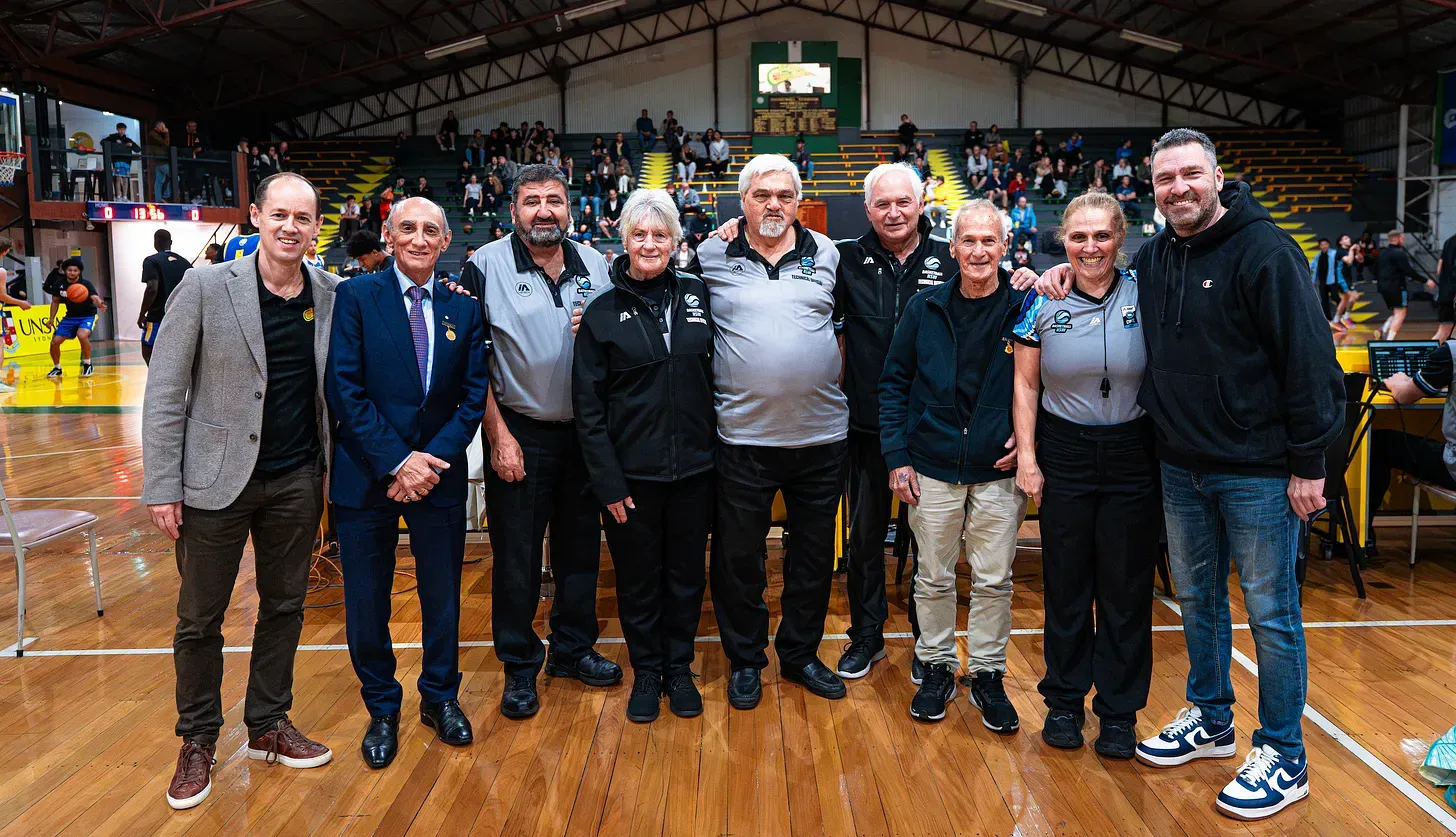 The Sydney Comets team with some of the City of Sydney Basketball life members. (Credit: Damian Fraser Clark)
If Andrew Lazaris is the guiding light and Mike Anderson the modern custodian, Brad Rosen is the connective tissue between the juniors and the various City of Sydney elite brands.
He is enjoying the game tonight from the Comets Bar above the court and everybody knows him and is keen to chat.
The hip hop is pumping over the speakers, generations of Comets fans are enjoying a Saturday night out and Rosen is in his element.
He first started playing at the Comets Stadium in 1985 as a fourteen-year-old who’d missed selection in his school cricket team. “There wasn’t a spot, so I was like, oh well, I’ll just go play basketball.”
His mum and dad had played. The barn on Maddox Street was a short trip from home. He came to the under-16s and he never left.
Within twelve months Rosen was floor-wiping for the Sydney Supersonics on game nights. He played Comets juniors, then Comets seniors when the rep teams took that name.
In 1992 he won an ABA national championship, the lowest of the three white banners hanging from the Comets Stadium rafters, which was broadcast on national television.
In 1994, the Comets ABA team was rebranded as Sydney Sky - the Sydney Kings’ youth-team affiliate, playing out of the same building, with the same juniors, against the same opposition.
Rosen played two seasons in the Sky kit. Boomer and Kings legend Matt Nielsen was his roommate.
“If I didn’t have Sydney Sky,” he says now, “I don’t make the Kings. That was the stepping stone.”
In 1995 he pulled on a Kings jersey for the first time. He went on to play 99 NBL games for them across five seasons.
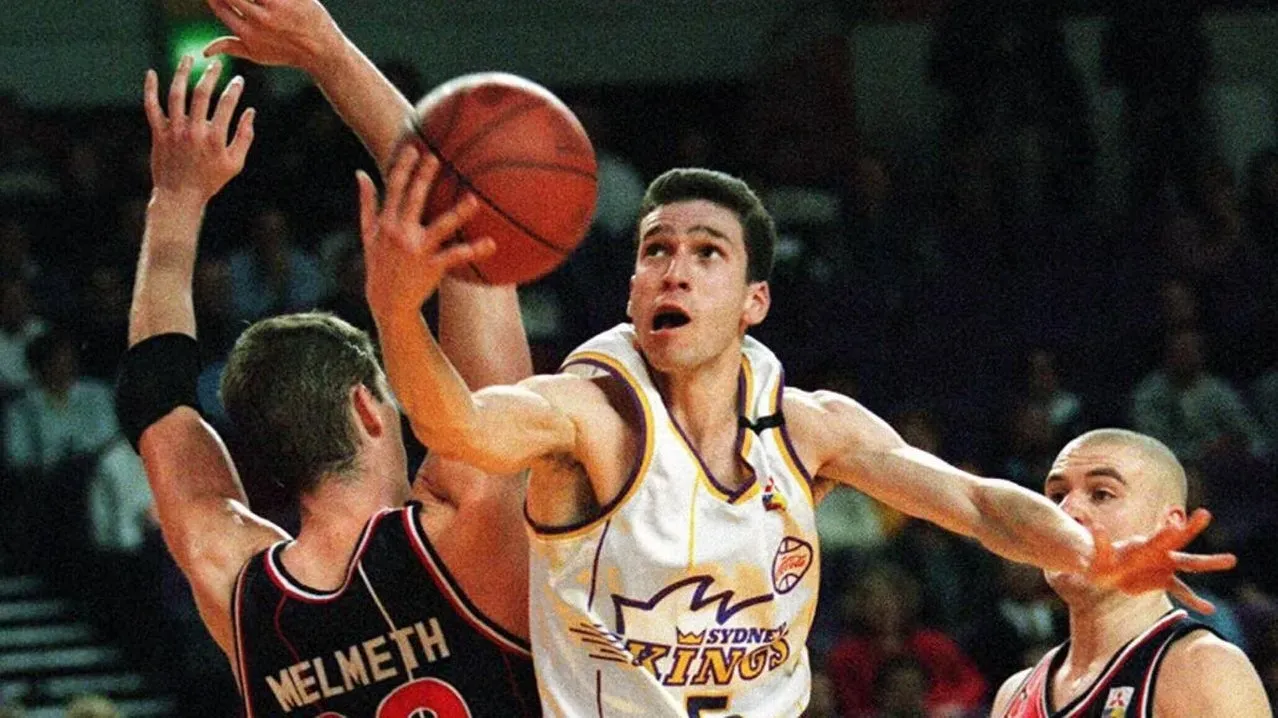 Local City of Sydney Junior Brad Rosen became a cult hero at the Sydney Kings.
He earned the nickname ‘Lightning’, a Tooheys television commercial, a dedicated section of fans at the old Sydney Entertainment Centre known as the ‘Brad Rosen Stand’, and eventually the captaincy.
He stayed with the Kings when Brian Goorjian tried to recruit him to Victoria. He came back as Goorjian’s assistant coach for the Sydney Kings’ first two championships in 2003 and 2004.
In 2002 he started a four-year stint as head coach of the Comets in ABA. He won the title in each of those four years. The four green banners hanging directly below his 1992 player banner are all his.
“One ring as a player. Four as a coach here. Two as an assistant coach at the Kings,” he says. “Six championships in four years. And every one of them is because of this gym.”
This club’s annual award for the most inspirational player carries his name.
Yet the line he keeps returning to is the one that most defines him.
“I never signed a contract with the Comets. I never got paid to play for the Comets. For me it was just home. There wasn’t anywhere else. You hated Bankstown. You hated Illawarra. You hated Norths. And you’d never, ever think of going somewhere else.”
Now, at fifty-four, he’s back on the club board. He coaches the under-14 girls because they needed a coach.
“It’s a privilege to put on that singlet,” he says.
“Because of the people who came before you. The blood, sweat and tears of people like Andrew Lazaris. Andrew is synonymous with this club. When you think of the Comets, you think of Andrew. When you think of Alexandria stadium, you think of Andrew. There’s no other club like this in Sydney. When people talk Sydney basketball, the Comets is the one they think of.”
“I’d be devastated if they knocked this building down.”
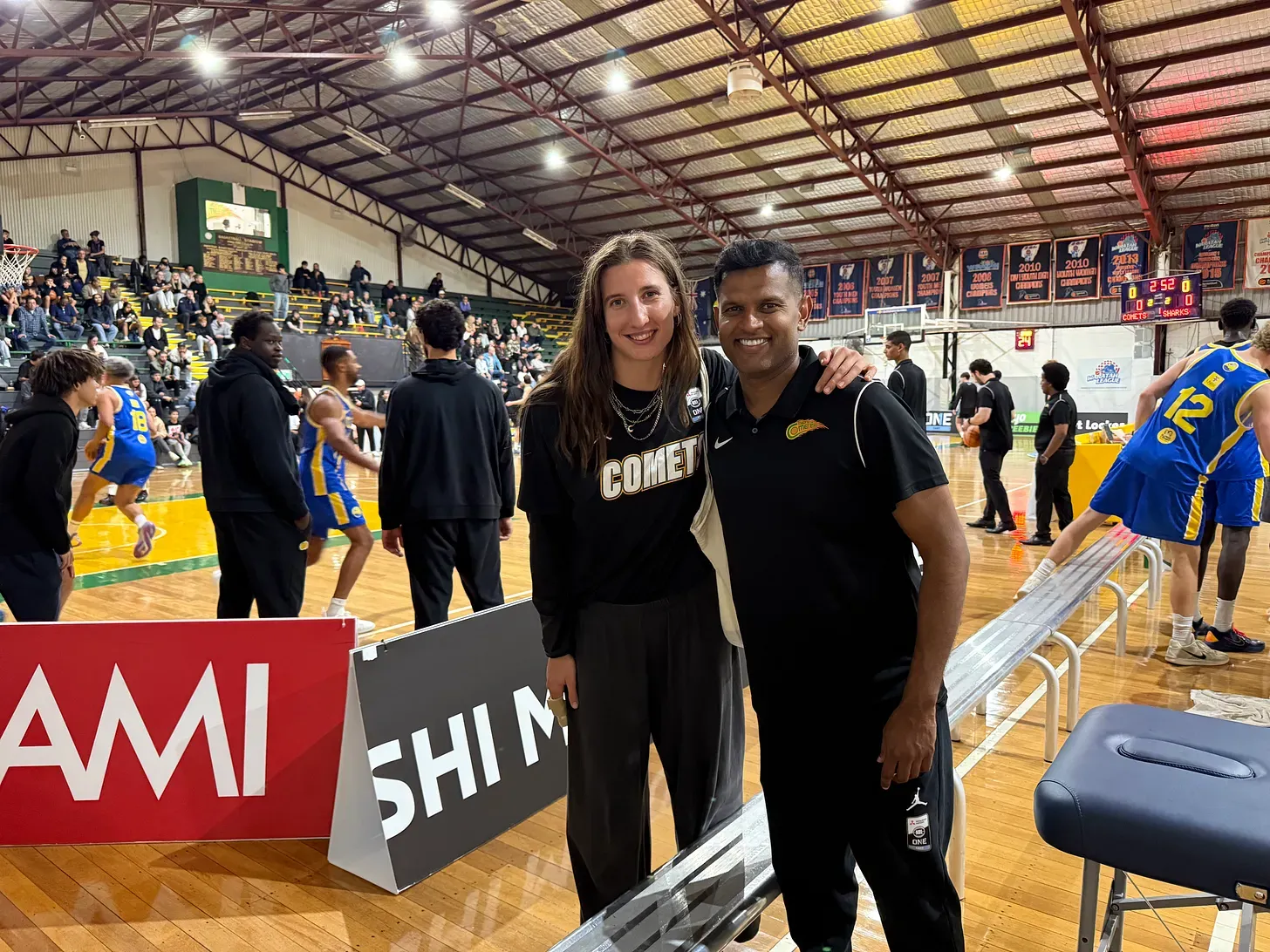 Chantel Horvat and Kumar Manix have been embraced by the Comets community.
There is another category of Comets person besides the Lazarises and the Rosens. Outsiders who were not part of the Comets family but have joined and been embraced.
Kumar Manix lives nowhere near Alexandria. He came here in the first place because his son had fallen in love with basketball after watching Biwali Bayles play for the Comets, and decided he wanted to wear green and gold.
Kumar volunteered to be team manager so he could see his son play and train. That was several years ago.
He has since managed the under-12s, the under-14s, the under-16s, and is now team manager of the Comets NBL1 East women’s program. In the off-season he is assistant team manager at the Illawarra Hawks in the NBL. He won the association’s Volunteer of the Year award last year.
If you ask Kumar to describe the Comets in one image, he reaches for an NBA analogy.
“There’s the Lakers, and then there’s the Clippers. The Comets are Clippers, the great underdog story. Hardworking. Our demographic, our fan base, our players, there’s nothing flashy about us. We come from all parts of Sydney to play. And we accept everyone who wants to play basketball and loves basketball.”
Standing next to Kumar in the upstairs concourse, watching the men warm up below, is Chantel Horvat. The Comets’ Women’s team lost their match to Sutherland, sorely missing Chantel, their injured marquee player.
Her CV is the inverse of Kumar’s. Geelong United junior. The youngest player in SEABL history at fourteen. AIS scholarship. Five seasons of US College basketball at UCLA in the NCAA. Professional stops in Poland, Turkey and Spain. Australian Opal. WNBL champion with Townsville Fire in March of this year. Then she joined the Comets.
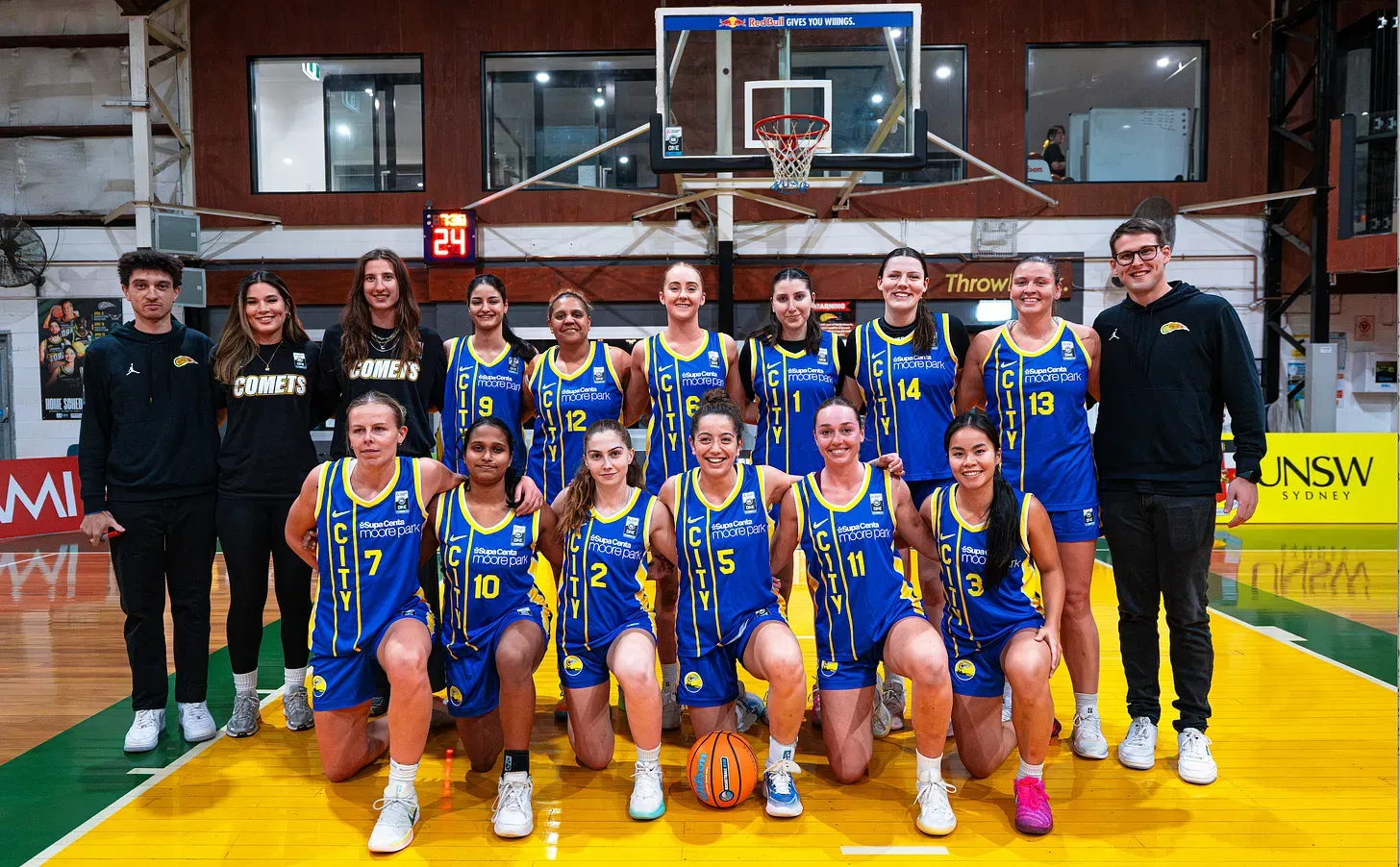 The Sydney Comets Women’s NBL1 East team in retro kit. Marquee player Chantel Horvat (top row, third from left) has been warmly welcomed by the club. (Credit: Damian Fraser Clark)
Eight weeks ago she was in her second training session as a Comet when she broke a bone in her shooting hand.
“It was pretty gruesome,” she says.
“My bone was sticking out of my finger.”
She’d played a single game in the green and gold scoring 37 points, 13 rebounds, 13 assists, and then disappeared into the rehab gym for two months.
She is the first to admit that she didn’t have to come to Sydney for her off-season at all. She had her pick of NBL1 clubs.
“I’d always wanted to play in Sydney one day,” she says.
“I knew people who’d played for the Comets. I’d been in this gym before, around the club. So this year was the right time and the right fit. I’m so grateful to finally be a Comet.”
“I love this gym. The incredible retro vibe. The banners on the wall, the colours, the feel. I’m in here every morning rehabbing, and there’s music playing, the men’s and the women’s teams are training together, and there’s this great energy and atmosphere. The DNA of this club is family. I’m a part of that now.”
She’ll play her comeback game tomorrow in Canberra. The team is driving down in convoy in their own cars.
Kumar Manix and Chantel Horvat: a part-time volunteer team manager who lives an hour from the stadium, and a championship-winning Australian Opal who could have signed anywhere in NBL1.
The Comets adopted both of them, and both of them lit up trying to find words for what that felt like.
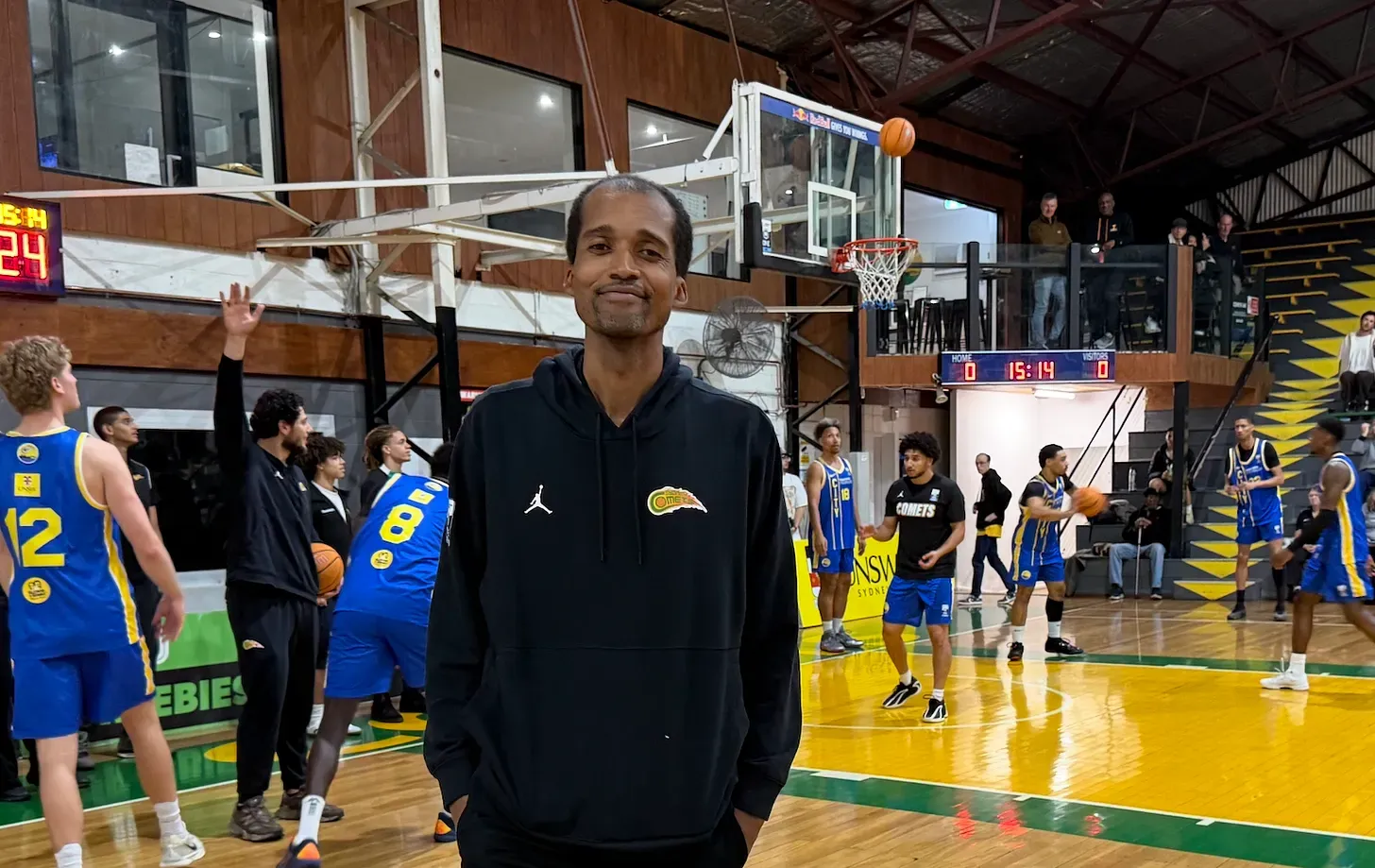 Sydney Comets NBL1 coach Will Hill appreciates the importance of the history behind Comets Stadium.
Will Hill is the head coach of the Comets NBL1 East men’s team. He has been at the club for eight years. He has coached at every age level from under-16s up. He is also not from around here.
Will and his Comets team are not having a good night against the Sutherland Sharks and are down at half time.
Originally from Mississippi, his mother was in the military, and the family travelled kicking off a wild journey. Kentucky, then Germany, then Georgia, then Hawaii, then New York, then Division III college basketball at Ithaca, then San Diego, then Sydney in 2010.
“My basketball smarts I picked up on military bases playing against soldiers,” he says.
That, more than anything else, explains the Comets’ on-court identity under his coaching.
“It’s a defensive-oriented philosophy. We want to be tough, full-court, hard-nosed. Make things difficult for your opponent. Unless you come from an officer’s background, which I didn’t, the military teaches you that. It fits.”
The Comets, he points out, also have a structural advantage that fits the same philosophy. “The court here feels smaller. Maybe it isn’t, maybe it’s a measurement thing, but it feels smaller. We’ve got a long, athletic team this year and we take up the whole floor. Opposition teams dread coming to play us at Alexandria.”
Of his player decisions this season, every one comes back to people he has known a long time.
Bailey Chambers. “I coached him at under-12, then again at under-16. I know the type of individual he is from a character standpoint.”
Obi Kyei. “I’ve known Obi since he was sixteen. I think I took him to his first weight-lifting session.”
Captain Johnny Crnogorac, a former Sydney Kings development player. “I assisted youth league in 2013. I knew Johnny then. That’s the rare thing in this game. You get to coach a junior, and then later in life, you get to coach the same person as an adult.”
On the heritage of the building itself, Hill knows the importance of a sacred space.
“I’m someone who loves history. A lot of basketball’s greatest stories are built on legacy, on what’s come before. Alexandria, being where it is and how long it’s been part of the Sydney basketball scene. It’s one of those gems where you can almost hear the ghosts in the building.”
Hill admits the specific blue-and-gold-Astronauts story was new to him until this week. The history, after all, is older than his time in the country.
“I’ll have a message in to the boys tonight,” he says,
“about honouring the people who came before us. Play the game the right way. Defend Alexandria.”
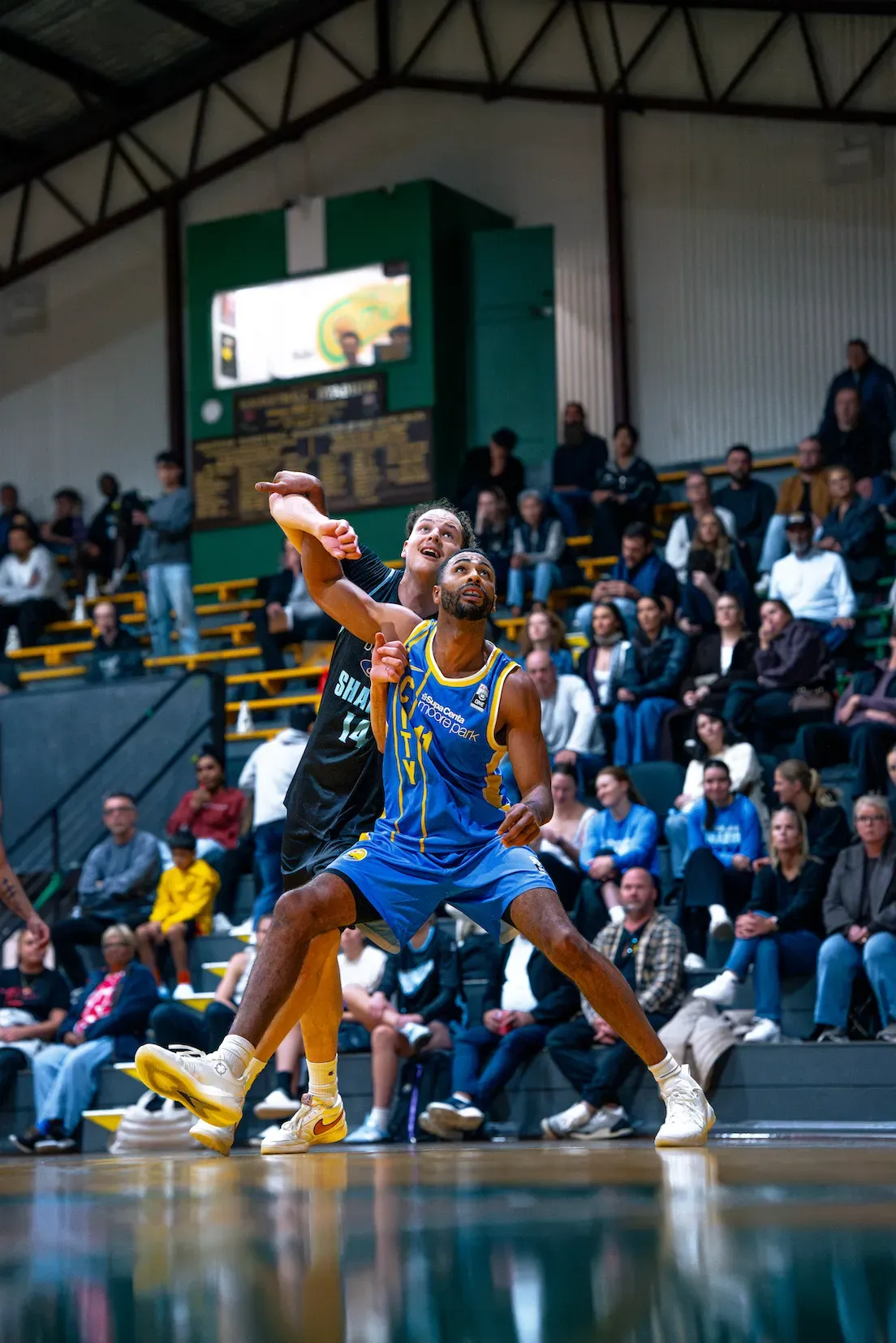 Obi Kyei is glad to be back at the Comets after a cross continental professional basketball journey. (Credit: Damian Fraser Clark)
Obi Kyei’s career did not start in traditional fashion. Born in Sydney to a Ghanaian father, he was brought up in the Blue Mountains, where his junior team used to lose to the Comets by fifty points.
He moved into the city as a teenager with big dreams.
“The Comets was always the place I wanted to play.”
He was named the Association’s player of the year in 2012. Then he progressed to the NSW Institute of Sport under Damian Cotter, who now coaches in the NBA.
He then won a college scholarship to Metro State in Denver. Culture shock led him to transfer to Eckerd College in Florida, which he describes as 'the best couple of years of my life.
Then professional basketball. Cuxhaven in Germany. A two-week interim posting in Leeds, in the UK, that ended with a broken foot and emergency surgery back home in Australia. Logan in the old Queensland Basketball League while he rehabbed. A move to Lleida in Spain — “the Spanish second division, which is the equivalent of most first divisions in Europe outside of France, Italy and the top tiers.”
Then home again, this time with NBL purpose. The Adelaide 36ers signed him in 2019 on a two-year contract. Then Covid arrived and a change of coach. The salary cap was renegotiated. He used the disruption as a fork in the road.
“I was about to start two businesses. I thought, with all this uncertainty, I’ll go and lock in on that. Be one of those guys who upskills in his mid-twenties rather than walking away from basketball in his mid-thirties and asking, now what?”
The businesses worked. He now runs an event-production agency working with Adidas, New Balance and Star Runner, plus a separate interior-architecture practice.
When NBL1 East emerged as a competitive professional league, he came back to basketball and there was only ever one club he was going back to.
“Where else would I go? Comets is my junior club. I know everyone there. It’s a community.”
“You walk into that building and you can feel the heritage. You see the same faces still there, however many years later, putting in the same energy. You see guys who hung a banner up there, who are older than you, still roaming around the gym, mentoring the younger kids coming through.
“That’s the reason I came back to Comets.”
“ The lifetime of work that people like Andrew have put in - you can feel it in the atmosphere. Whether it’s a Monday-night junior game or an NBL1 game.”
Now a senior team member talking to the younger players, he has the perspective only someone who has been the kid in the building can have.
“When you’re the younger guy with aspirations to go to college or play in the NBL, you see the club as a means to an end.”
“But then you come full circle. You’re the older one. You see the next generation coming up. And the importance of the club culture, of the community.”
“It resonates and it’s important. You realise that what you say to a fourteen-year-old today might be the thing that sticks for him in twenty years.”
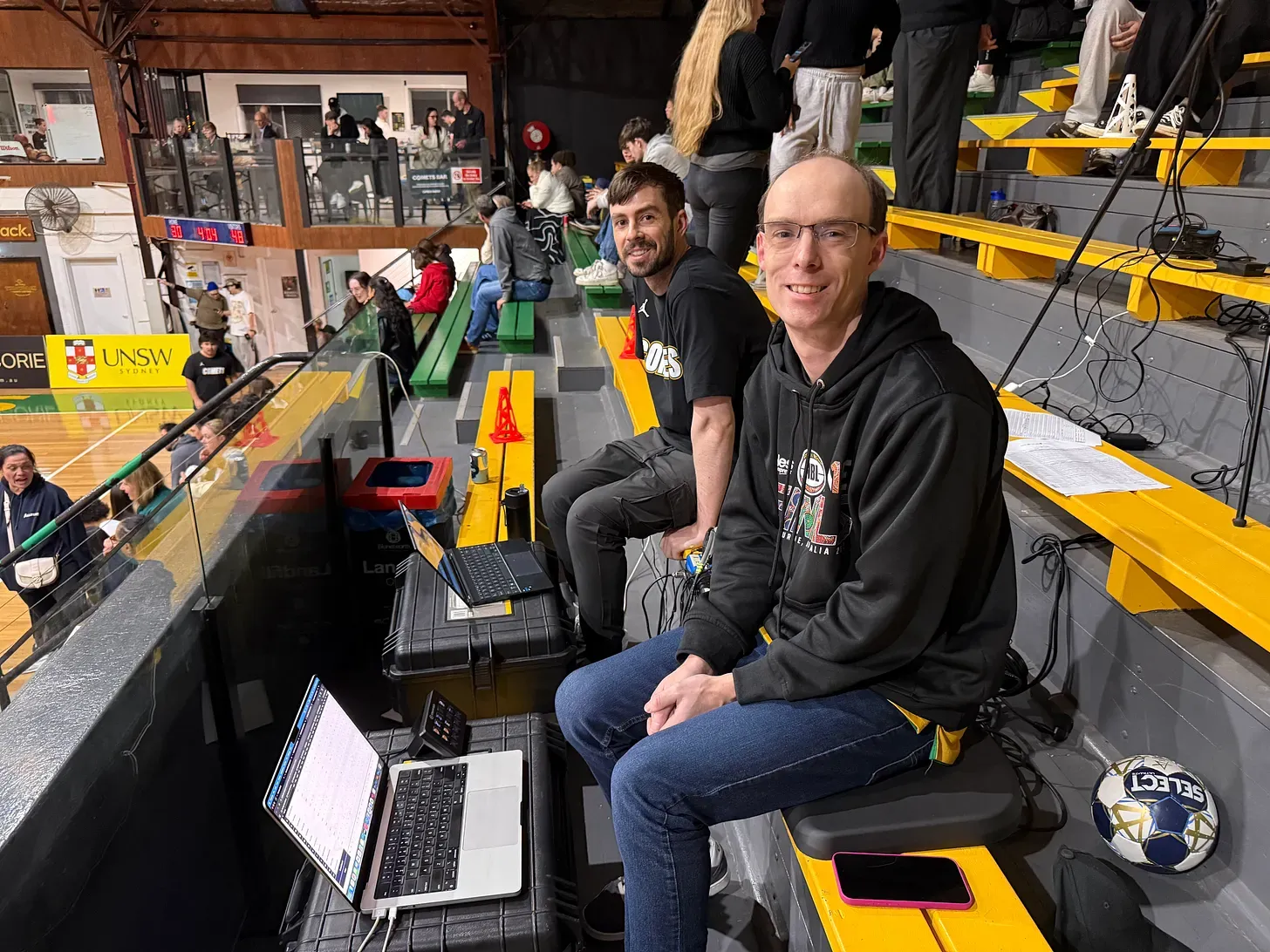 NBL1 East commentator Lachy France loves coming to Comets Stadium.
Lachy France is the match commentator for the NBL1 East live stream.
It is his fiftieth game calling a Comets team but he is not, strictly speaking, a Comets man. His primary club is Sutherland, but he says he feels just as welcome walking into Alexandria as he does on his home floor.
“This is the home of hoops in New South Wales,” he says, from the commentary area on the mezzanine at half-time.
“It’s an inner-city club with so much history. Everyone knows the Comets. You look out there tonight both teams have Comets juniors on them. You look across the league, the Comets have produced so many players over the years. And to do it all out of this little two-court facility, when Bankstown has seven courts and Newcastle has ten, and everybody else has four or six.”
“They just keep producing and players love to come here.”
“It’s a club that welcomes anyone. It represents from the eastern suburbs and the private-school boys, all the way down through the south to the inner city. It’s a real mesh of socioeconomic regions and cultures. It gets people out of their circle.”
Joyfully for Lachy and sadly for the Comets fans, the Sutherland Sharks win the match 87-62. An off night for the Comets and their one night back in the old blue and yellow was not a winning one.
But there is no time for reflection. The team has to hit the road to play the Centre of Excellence in Canberra the following day.
It will be their teammate Goc Malual’s last match for the Comets before he joins the University of Colorado’s basketball program and they will want him to go out in style.
Another success story launching out of the Comets.
* * *
There is a particular form of devotion required to keep a club like this alive.
The Sydney Comets do not have a 2000-seat stadium. They do not play their home games on free-to-air television. Sponsors are tough to come by in a competitive market.
Their NBL1 East budget is a fraction of what the bigger southern clubs spend, and they lost their top junior, Biwali Bayles, to Bendigo this season because the money was simply better down there.
But they have a special sauce that other clubs can’t create. They have the deep, intergenerational lineage that kickstarted professional basketball in Sydney.
They have the Tin Shed filled with the ghosts of past legends.
They have, in Andrew Lazaris, a man who has supported all of City of Sydney's teams for fifty years. A man who pulled the Sydney Kings out of administration with a personal cheque so the brand he had helped build wouldn't be erased
They have, in Brad Rosen, a one-club man across four different brand names who turned down better offers because going somewhere else was unthinkable.
They have, in Will Hill, an American coach who has been at one club so long he is now training the children of the under-16s he used to coach.
They have in players like Obi Kyei, for whom the club culture is so deeply hardwired into their DNA at junior level that paying it forward to the next generation happens naturally without obligation
And on Saturday night, in an old tin shed just off Bourke Road, they have twelve men and women in blue and gold running out in the colours their forebears wore on the night basketball became a professional sport in this country.
A salute to the City of Sydney Basketball Association and to the small group of people who have refused, year after year, decade after decade, to let it become anything other than a close family and community bound by basketball.
Astronauts. Supersonics. Sky. Kings. Comets.
All born on the same court. All raised under the same roof.
May the old Tin Shed in Alexandria continue on for another 60 years.


More News



Naming Rights

Major Partners

.avif)

.avif)